Reimagining India's Kings and Queens through AI
AI is rapidly becoming part of how people and industries create, work, and solve problems. From design and filmmaking to photography and storytelling, AI is making complex creative processes faster, easier, and more accessible.
This project explores that shift through visual storytelling—using AI to transform old hand-drawn portraits of Indian kings into realistic photographic interpretations and cinematic video. It examines how easily AI can turn a simple historical reference into an immersive visual narrative while preserving its original cultural identity.
/ Disclaimer:
The historical kings and queens depicted in this project are AI-generated artistic interpretations based on old illustrations and reference artwork. Their facial features, appearance, clothing, and overall representation may differ from their actual historical appearance or existing depictions. These visuals are created solely for artistic and experimental purposes, to explore the capabilities, accessibility, and creative applications of AI in visual storytelling. The generated representations should be viewed as creative interpretations rather than historically verified or definitive depictions.
The Story Behind the Project
The idea for this project came from a quiet visit to a local bookstore. While browsing through a stack of books, I came across a chart featuring portraits of some of India's most iconic kings. The illustrations were looking hand-painted in a simple, traditional style—full of character, but shaped by the limitations of the printing techniques of their time. As I looked at them, I began to wonder: What if these portraits had been captured by a camera instead of painted by hand?
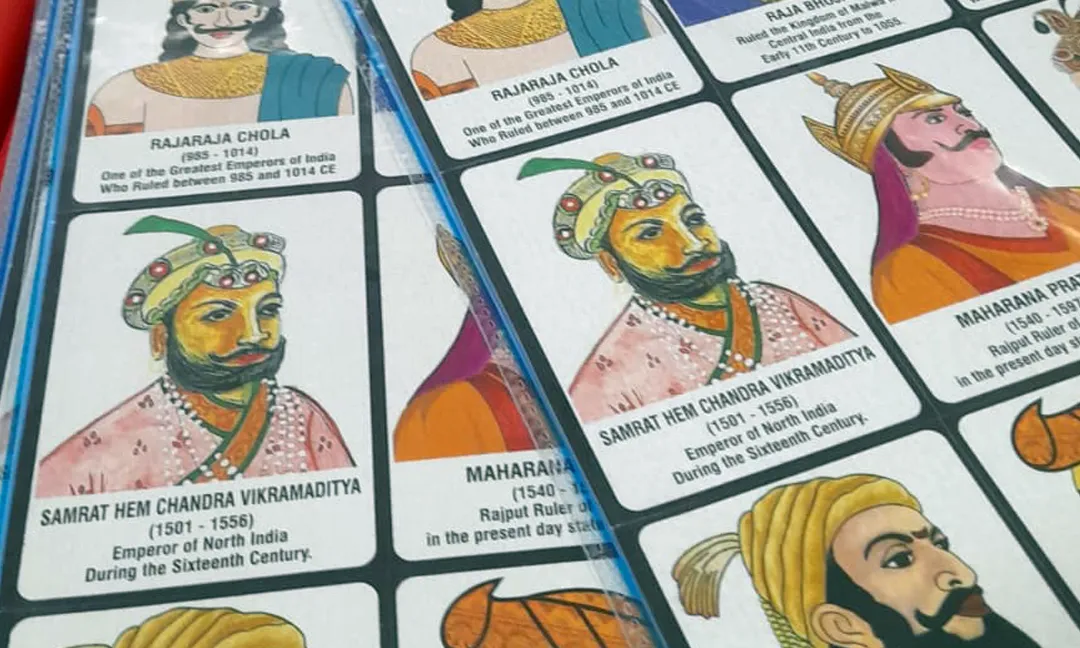
Reimagining Historical Art with AI
In this project, I used AI tools such as ChatGPT, Google Gemini, Google Veo, and Adobe Firefly to create photographs and videos. I first asked ChatGPT to develop detailed prompts for transforming the hand-drawn artwork into realistic photographic interpretations while preserving the historical aesthetics, attire, jewelry, and overall visual character of the original artwork. I then used these prompts to explore how AI could transform a hand-drawn historical portrait into a realistic photograph and extend it further into visual storytelling through AI-generated video.
Prompt:
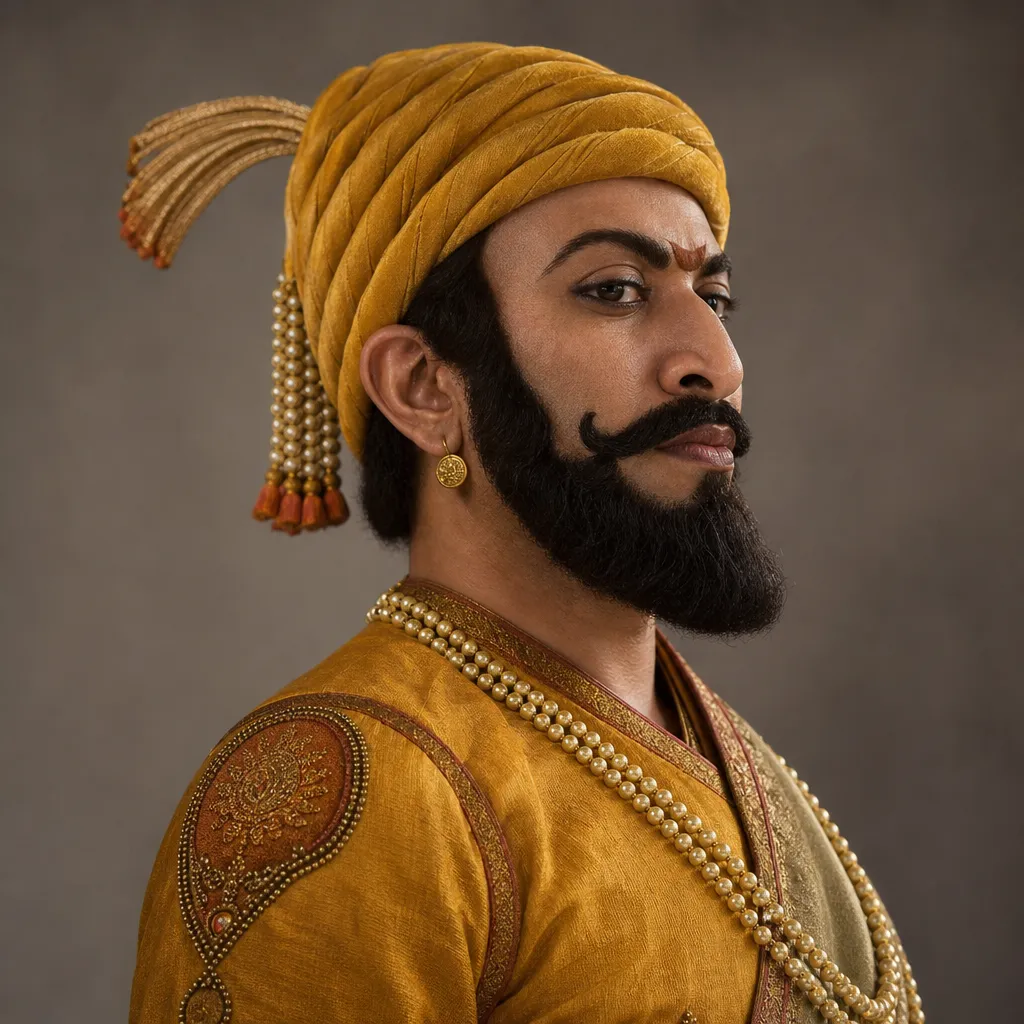
Transform the attached historical artwork into a photorealistic 16th-century royal portrait of (Name) Preserve the original character, facial features, turban, clothing, jewelry, embroidery and ornaments, while correcting perspective, proportions and anatomy naturally. Make the skin, hair, fabric and jewelry look physically real and historically authentic. Place the subject in a modern professional digital photography studio with a clean neutral background, soft cinematic lighting and realistic shadows. Keep the person and attire completely period-authentic. Square 1:1 composition, centered head and upper torso, full turban visible, photorealistic, documentary photography, natural skin texture. No text, letters, captions or watermark.(Used this single prompt for all image)
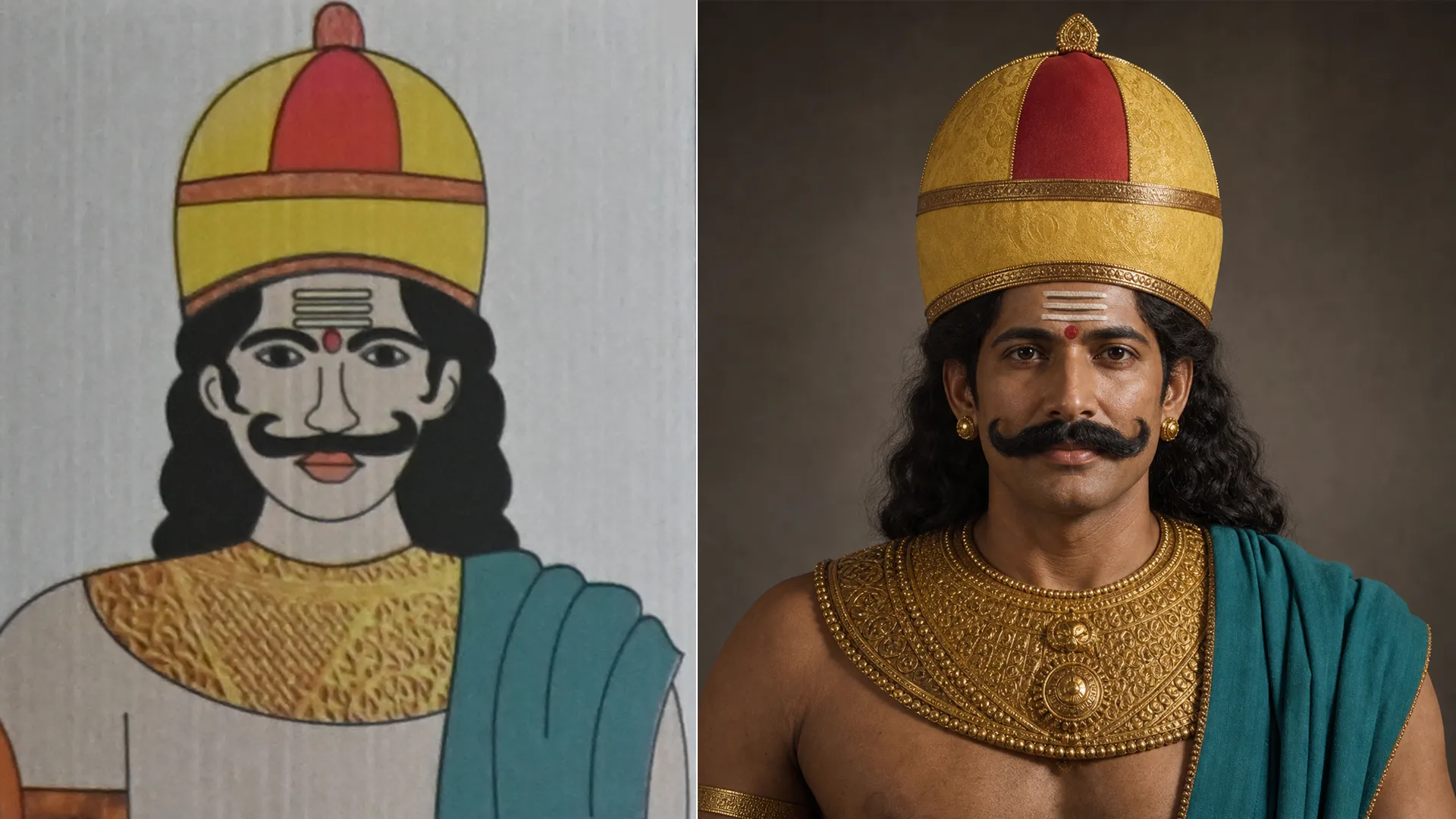
Rajaraja Chola | ChatGPT2 in Firefly
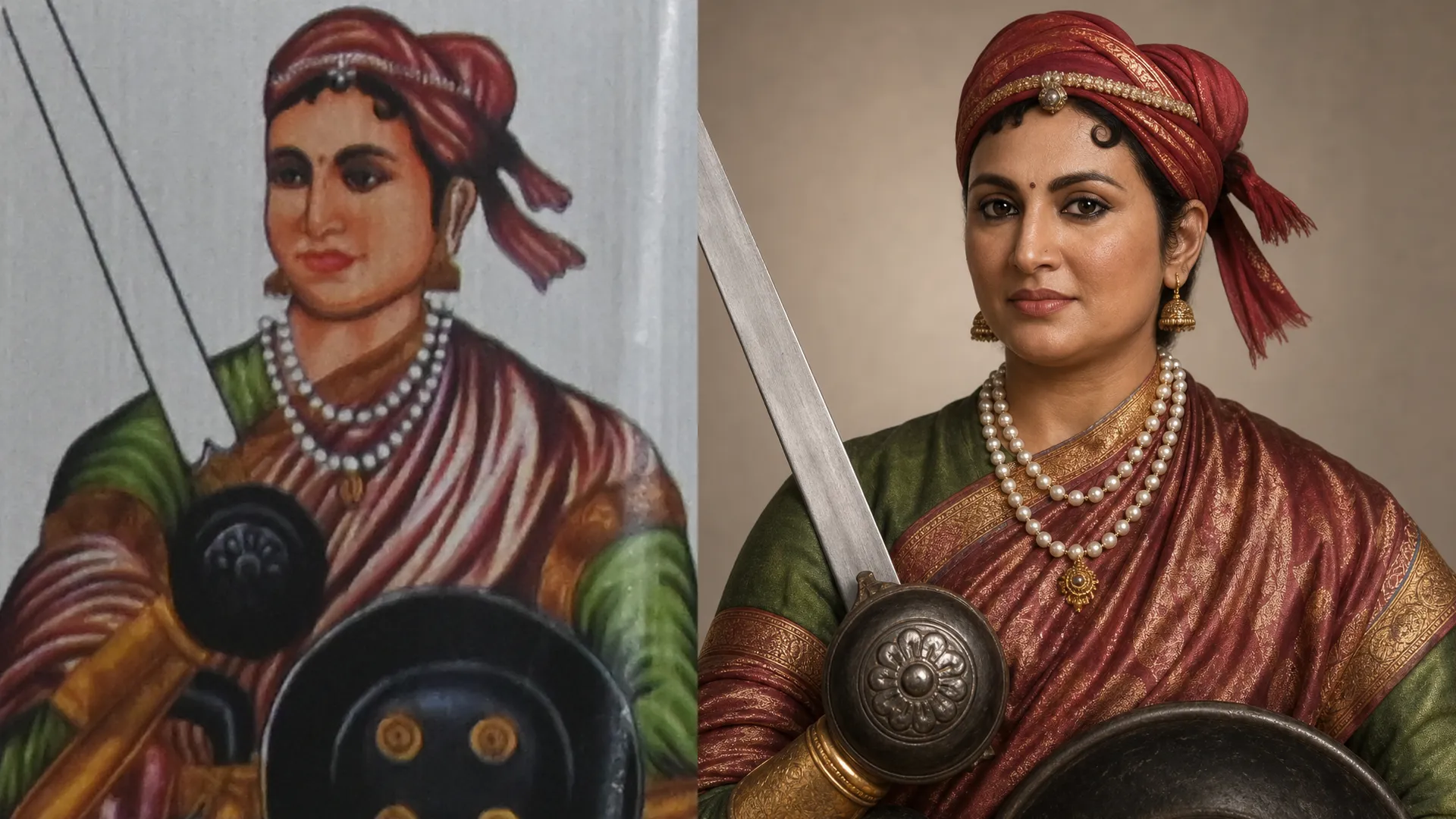
Rani Lakshmi Bhai | ChatGPT2 in Firefly
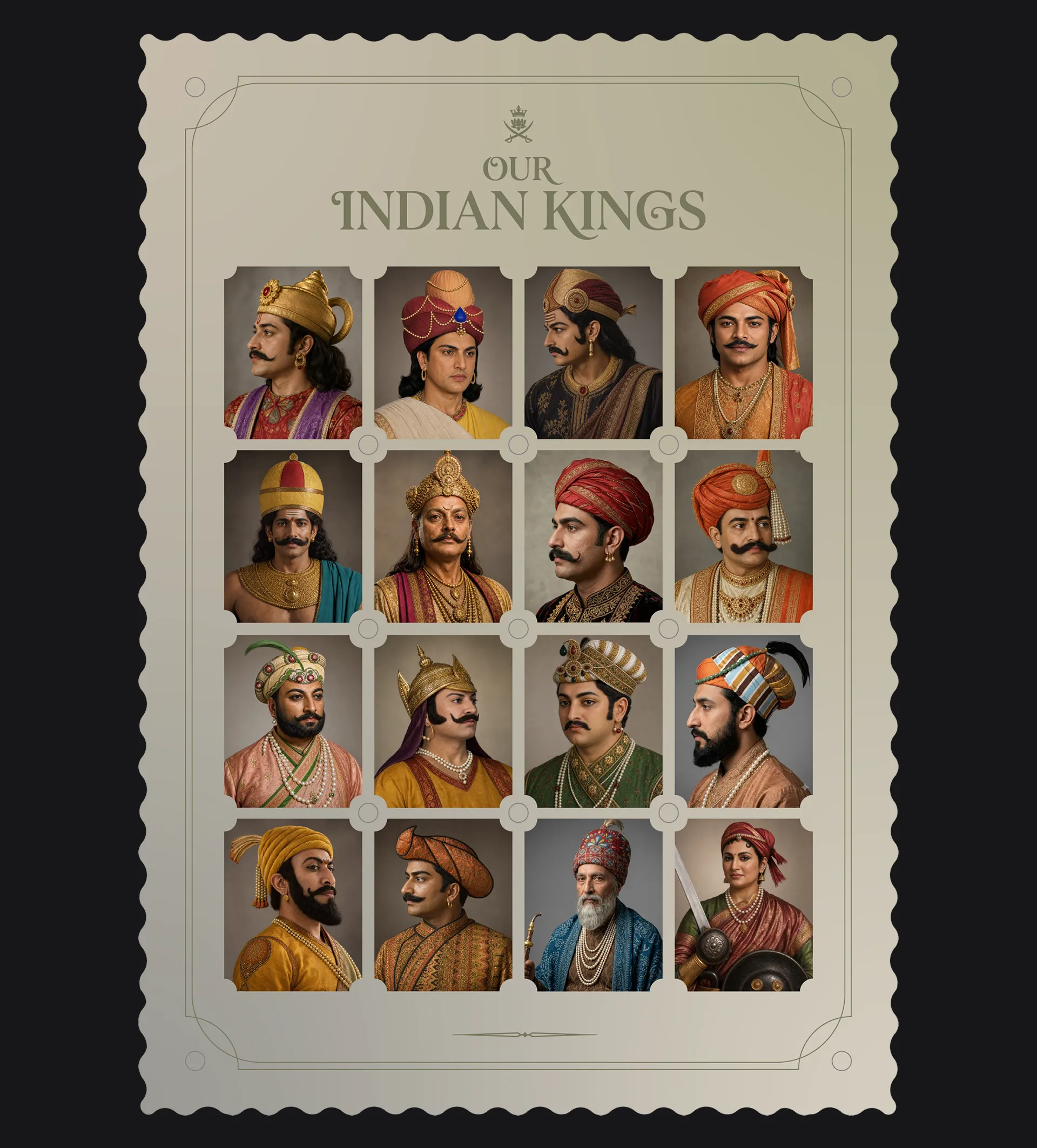
Re created Poster design | Adobe Illustrator
The transformation from the original hand-drawn artwork to a realistic photograph
turned out remarkably well. The attire, turbans, jewelry, ornaments, and overall historical
aesthetic were closely preserved, while the facial features were naturally interpreted by AI.
Apart from two attempts, most of the results were achieved in the very first generation.
No post-production, retouching, or manual image editing was
done—the images shown are the raw outputs generated directly by AI.
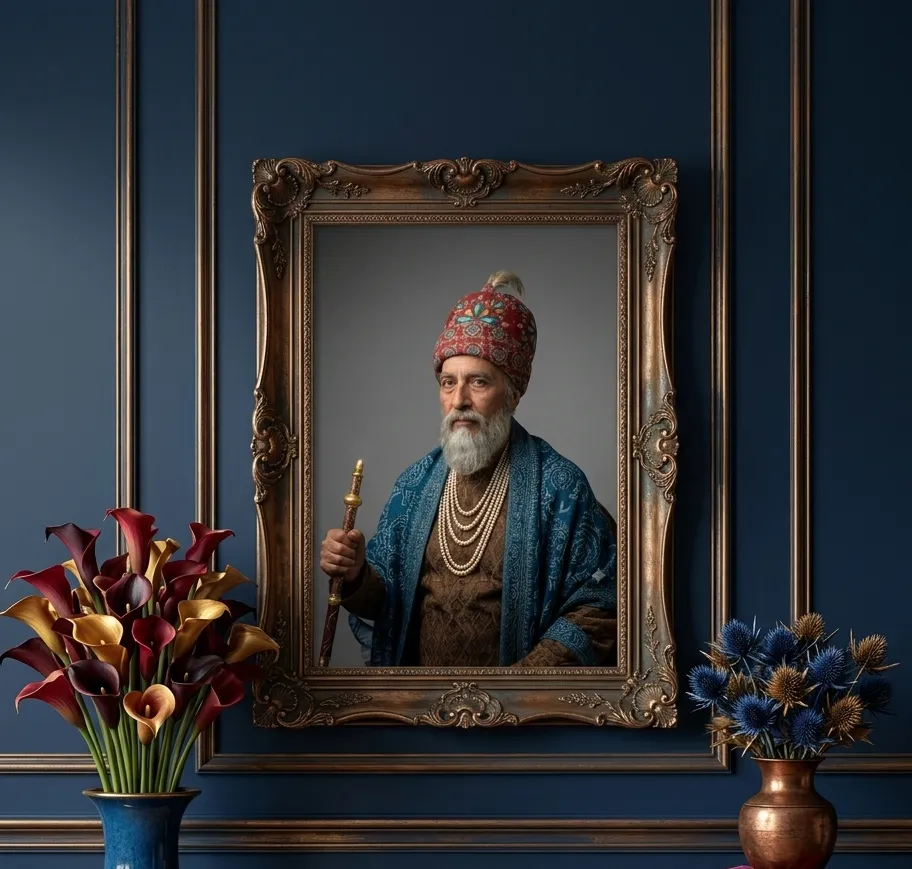
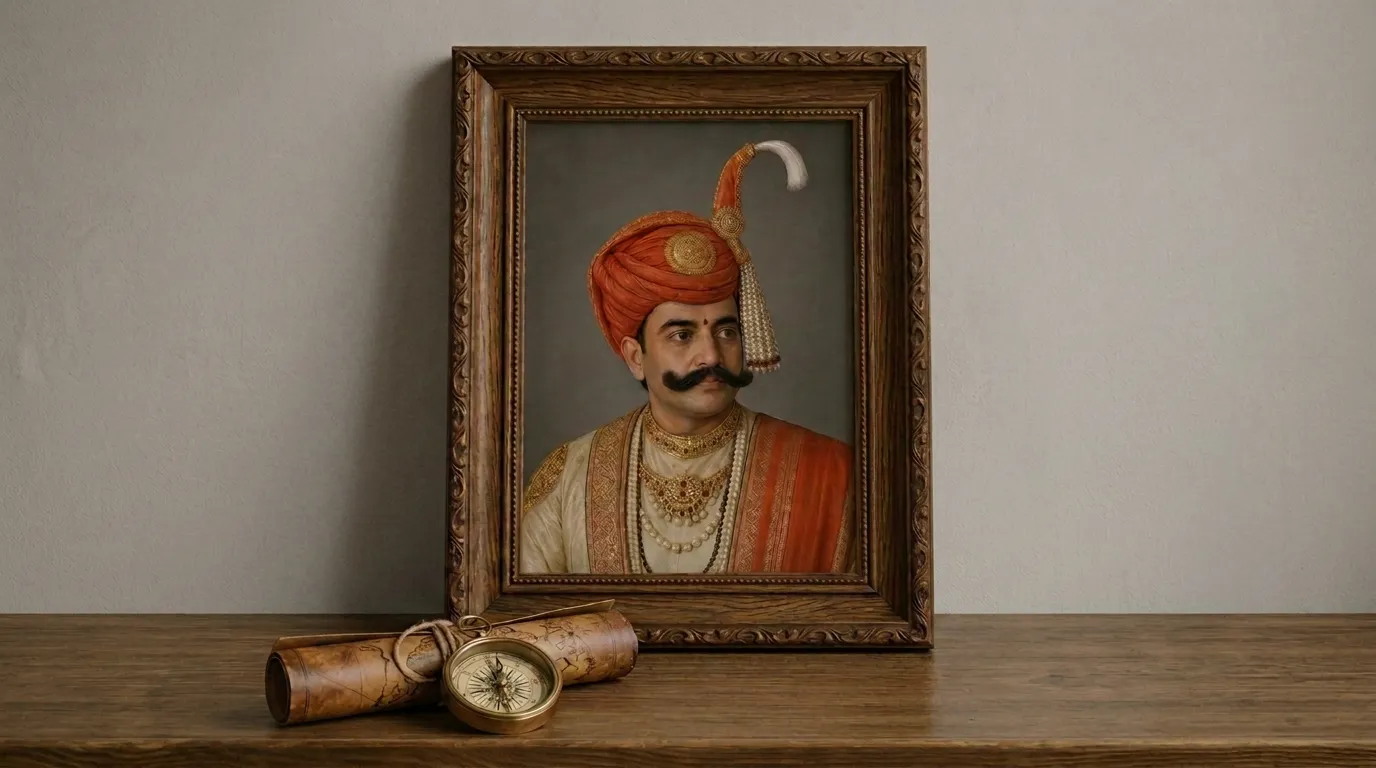
Below are a few mockups created using these AI-generated photographs to explore how the characters
could be presented in different visual contexts.
Google Gemini — Direct Web
Google Gemini — Direct Web
Google Gemini — Direct Web
Exploring Rani Lakshmibai Through Visual Storytelling
The results from the initial image generation sparked my curiosity to explore further. I decided to experiment with how AI could be used to visually narrate the life of Rani Lakshmibai by recreating key moments from her history. Using a Wikipedia reference as the historical source, I asked ChatGPT to identify important moments and develop two to three detailed visual prompts. I then used these prompts to generate cinematic interpretations of those historical events.
Below are the prompts generated by ChatGPT, followed by the images created from them.
Prompt:
Cinematic historical scene of Rani Lakshmibai defending Jhansi Fort during the 1858 siege, 19th century India, Rani Lakshmibai standing on the massive stone ramparts wearing traditional Maratha royal battle attire, deep red and dark saffron sari adapted for battle, ornate but practical armor, sword at her side, looking fiercely toward the British army surrounding Jhansi, Indian soldiers operating large period cannons beside her, smoke and dust filling the battlefield, cannon fire illuminating the distant landscape, massive weathered granite fort walls, British troops and artillery visible far below, horses and soldiers moving through the chaos, dramatic late-afternoon sunlight cutting through battlefield smoke, historically grounded architecture and clothing, realistic Indian faces, epic scale, cinematic composition, natural colors, gritty period realism, volumetric atmosphere, shallow depth of field, 35mm historical epic cinematography, extremely detailed, photorealistic, 16:9, no text, no modern objects, no fantasy elements.
Rani Lakshmi Bhai, 1858 siege | Gemnai NanoBanana 2 in Firefly
Prompt:
Epic cinematic night escape of Rani Lakshmibai from the besieged Jhansi Fort in 1858, Rani Lakshmibai riding a powerful dark Marwari horse at full speed through a narrow stone passage outside the fort, dressed in historically inspired 19th-century Maratha battle clothing, flowing red sari, traditional armor, sword firmly in her hand, intense determined expression, the fortress of Jhansi burning behind her, distant British soldiers and smoke silhouetted against the orange glow of fires, dust and sparks flying beneath the horse's hooves, moonlight breaking through heavy smoke and clouds, dramatic low-angle camera close to the horse, dynamic motion, realistic horse anatomy, authentic Indian historical environment, emotional and heroic but not exaggerated, cinematic lighting, muted earthy colors with warm firelight, gritty realism, large-scale historical epic, 35mm film look, photorealistic, extremely detailed, 16:9, no text, no modern objects, no fantasy armor.
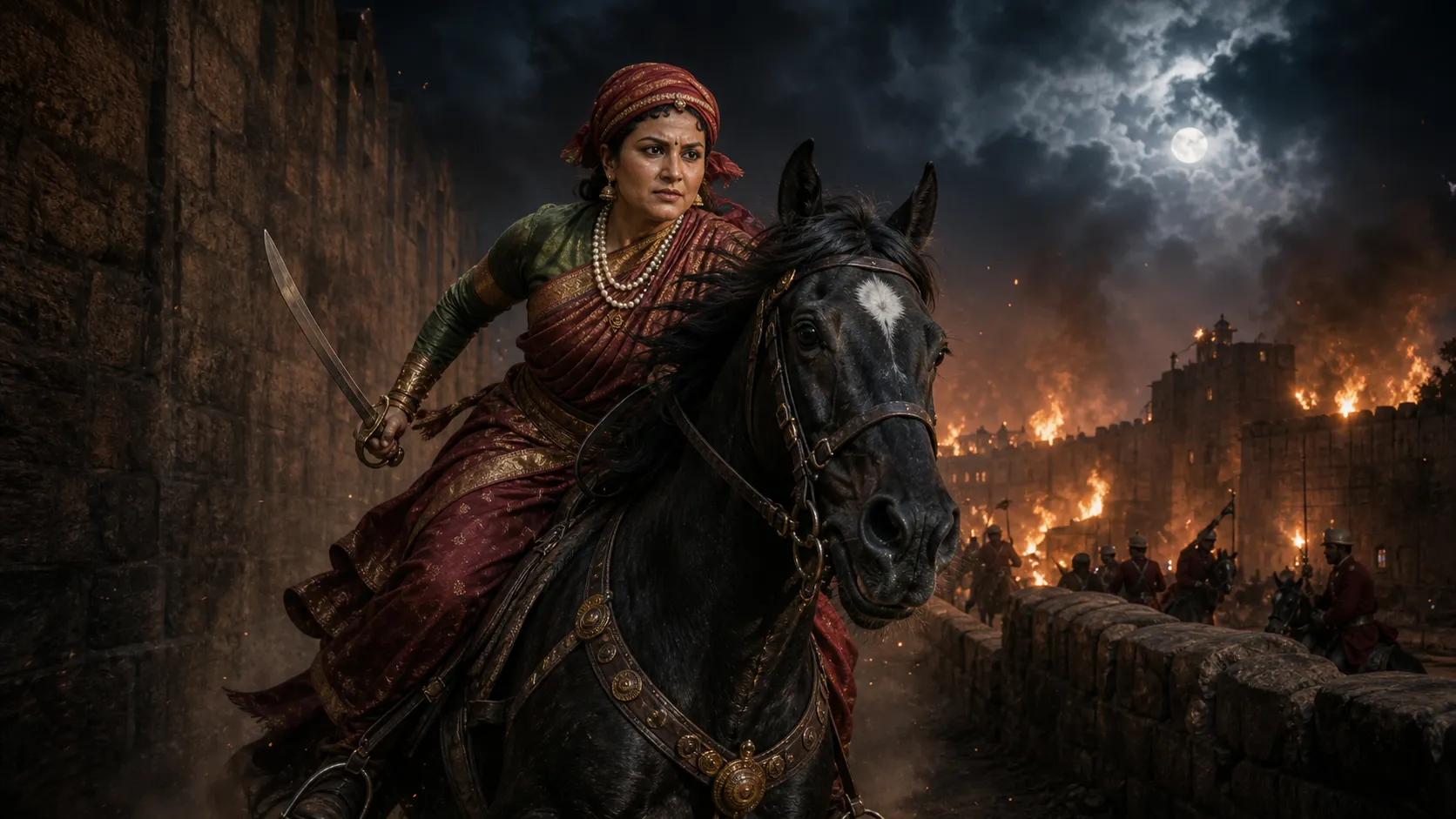
Rani Lakshmi Bhai, The Night Ride | GPT2 in Firefly
From Concept to Cinematic Frames
Next, I planned to turn the visual story into a video. I asked ChatGPT to create scene-by-scene image prompts based on a rough visual idea I provided. For example, I wanted to create a sequence of Rani Lakshmibai riding a horse, using different camera angles and close-up shots to build a cinematic sequence:
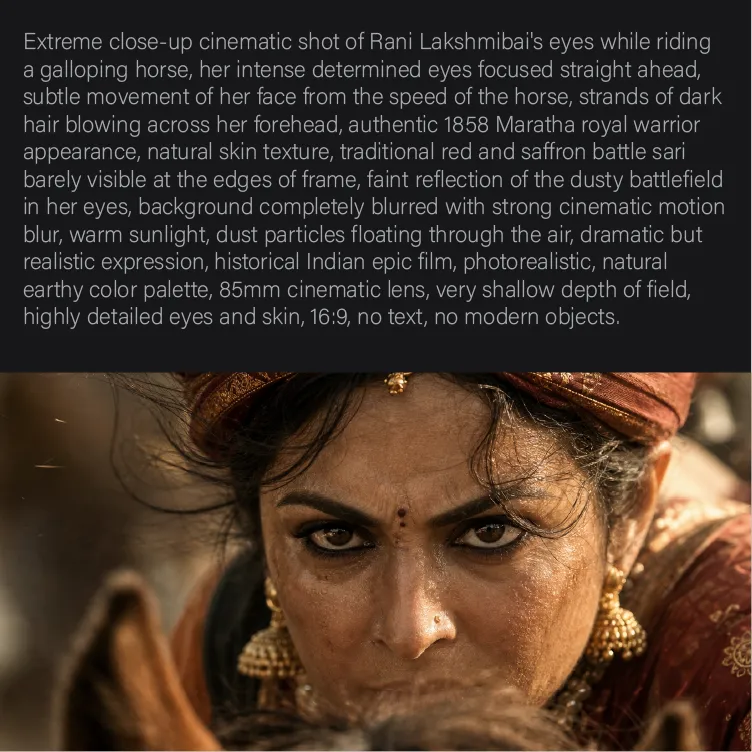
- Image 1: Close-up shot of Rani Lakshmibai’s eyes while riding the horse.
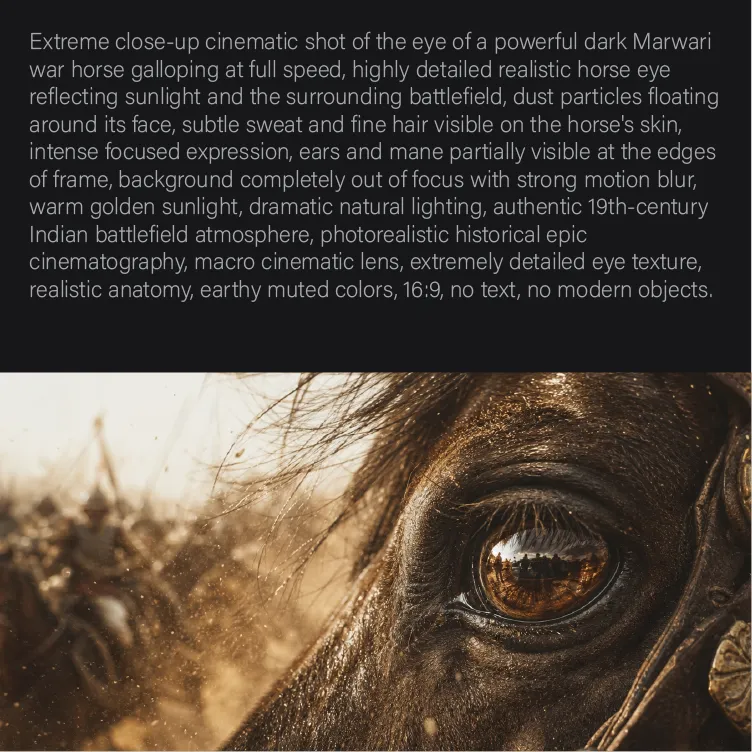
- Image 2: Close-up shot of the horse’s eyes while in motion.
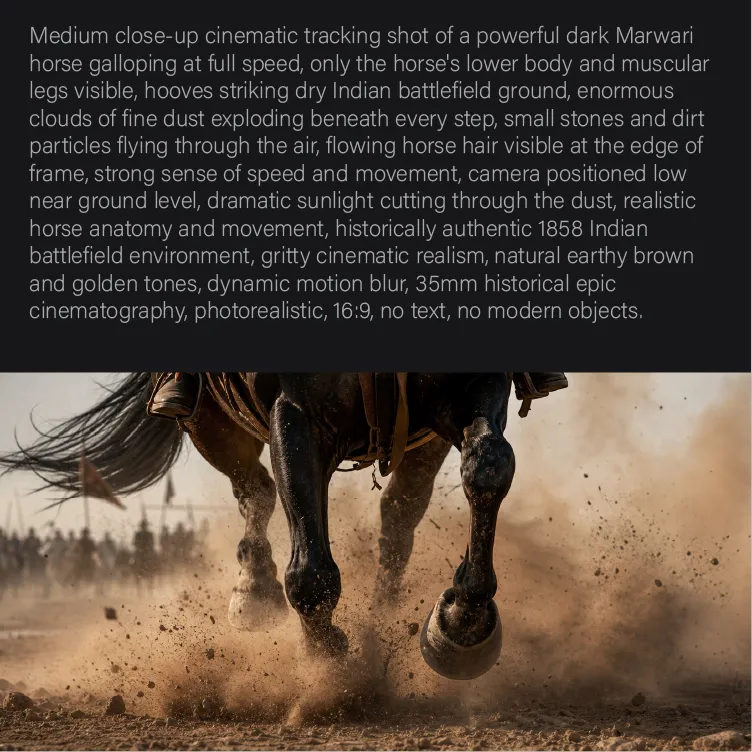
- Image 3: Medium close-up of the horse’s running legs, with dust rising from the ground.
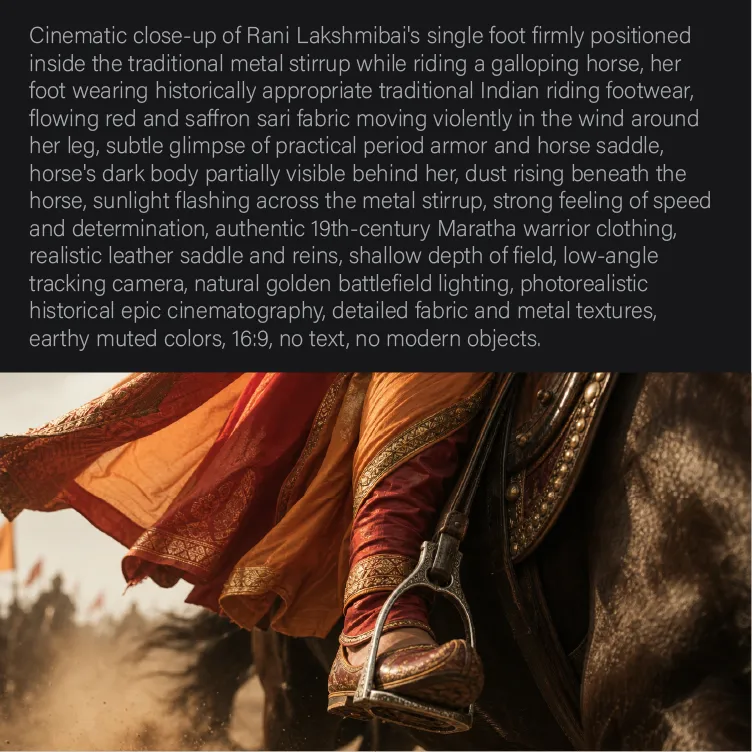
- Image 4: Close-up of Rani Lakshmibai’s foot resting in the stirrup while riding.
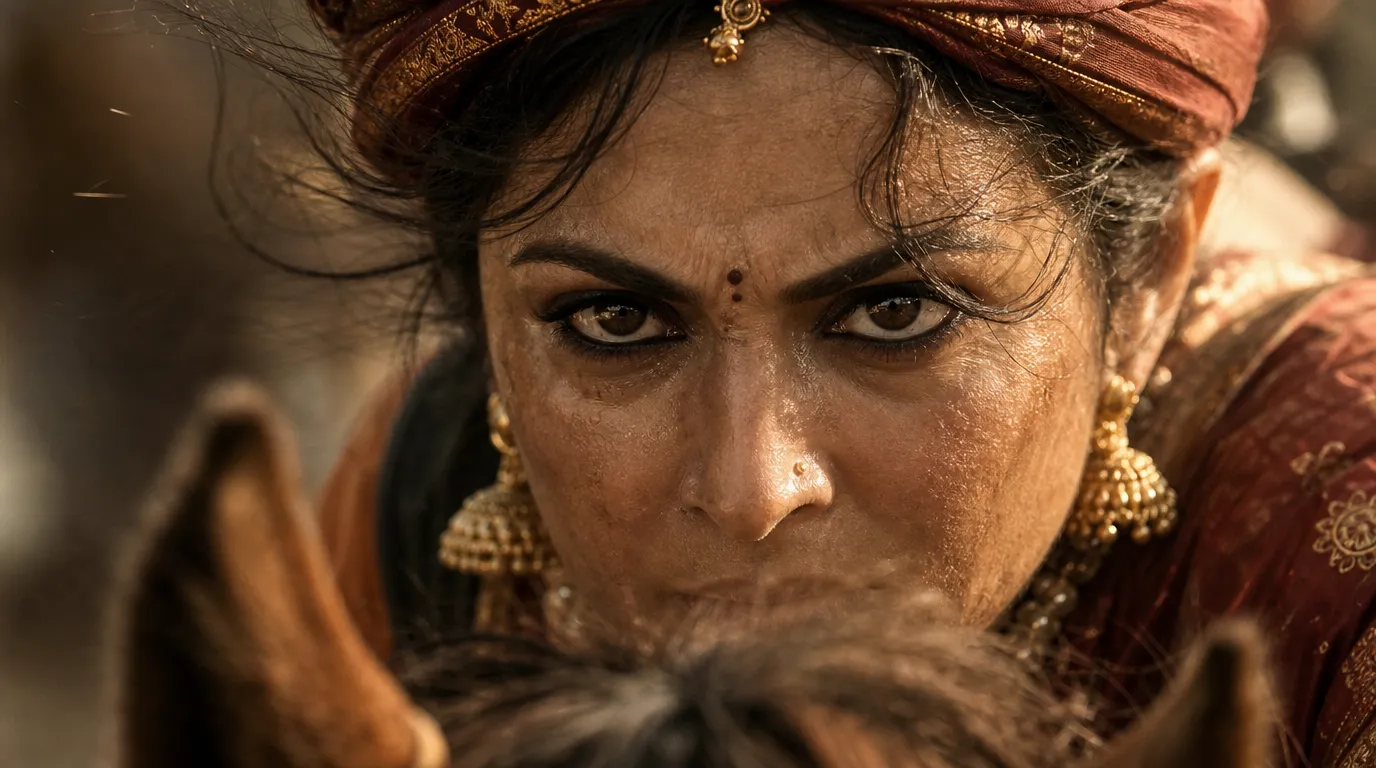
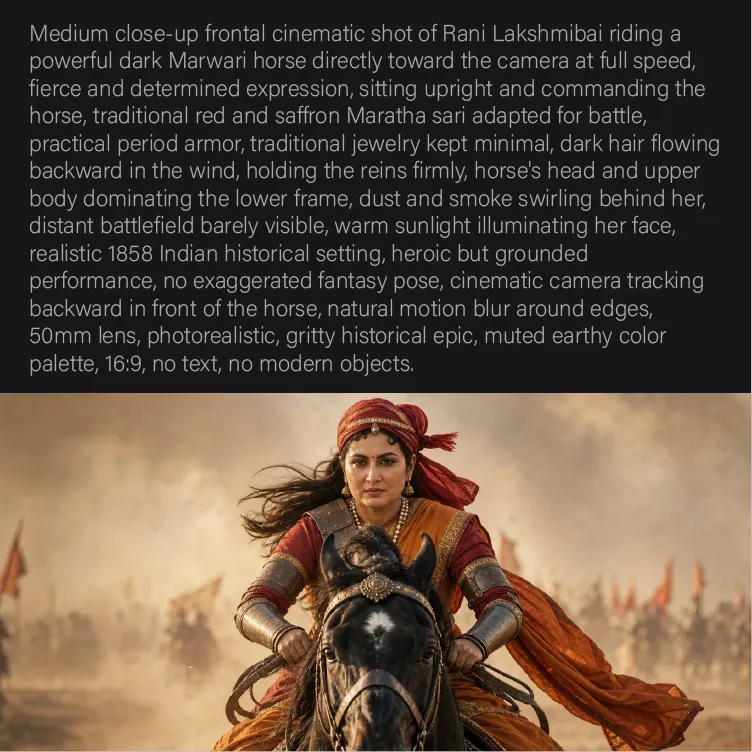
- Image 5: Medium close-up, front-facing shot of Rani Lakshmibai riding the horse.
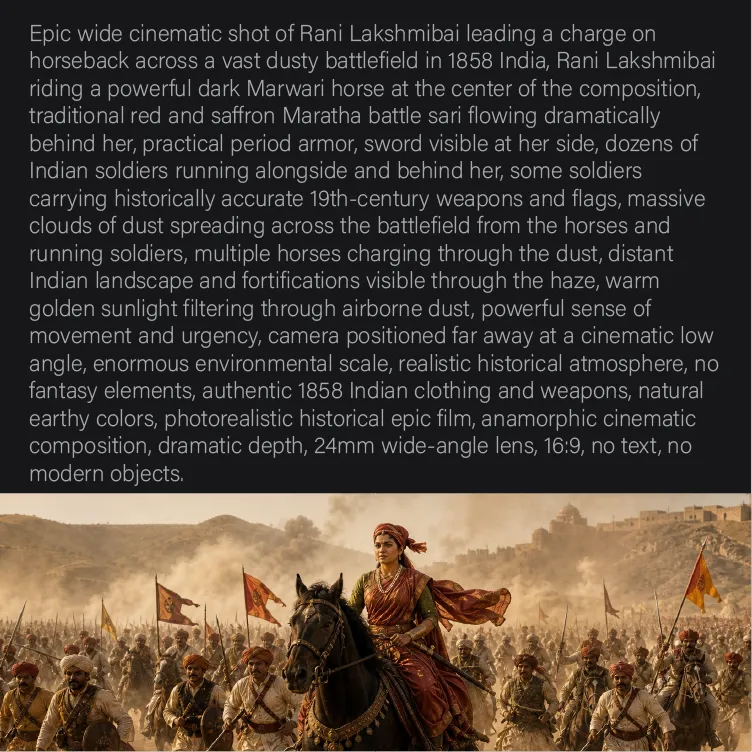
- Image 6: Wide cinematic shot of Rani Lakshmibai riding through the battlefield, with dust spreading around her and soldiers running alongside her and the horse.
Below are the prompts used to generate each scene, along with their corresponding AI-generated visuals using GPT2 in Firefly
Bringing the Scenes to Life with VEO
For video generation, I used Google Veo on the free tier. It made the process simple and accessible—turning my generated images and prompts into cinematic video scenes. The results were surprisingly good. I achieved almost exactly the footage I had imagined on the first attempt, with natural character and horse movement, camera motion, dust, and cinematic atmosphere. It demonstrated how AI can turn a simple idea and a few prompts into compelling video, without the need for a traditional production setup or extensive post-production.
Prompt:
Scene1: Cinematic slow-motion close-up of Rani Lakshmibai riding a powerful dark Marwari horse at full speed. The camera remains at a consistent close-up distance with no zoom in or zoom out, smoothly tracking alongside her. Her eyes stay sharply in focus throughout. Her hair and red-saffron sari flow naturally in slow motion, while dust particles and sunlight drift through the frame. Shallow depth of field, soft background motion blur, warm golden light, realistic horse movement, photorealistic 1858 Indian historical epic, cinematic 35mm look, smooth continuous camera movement, 16:9.
Scene2: Cinematic slow-motion extreme close-up of the dark Marwari horse's eye while galloping at full speed. The camera maintains a constant close-up distance with no zoom in or zoom out, smoothly tracking alongside the horse with subtle natural camera shake from the galloping movement. The eye remains sharply in focus throughout. Dust, fine hair and sweat move naturally in slow motion, with the dusty battlefield softly blurred in the background. Warm golden light, shallow depth of field, photorealistic 1858 Indian historical epic, cinematic 35mm film look, immersive and realistic, continuous shot, 16:9.
Scene3: Cinematic slow-motion front-facing shot of the powerful dark Marwari horse's front legs galloping directly toward the camera. Only the front view is visible — never show the side of the horse. Camera slowly pans left to right while maintaining the frontal perspective, with steady movement and very subtle natural camera shake. Hooves strike the dry ground, creating dramatic clouds of dust in slow motion. No zoom in, no zoom out. Warm golden sunlight, shallow depth of field, realistic leg movement and dust particles, photorealistic 1858 Indian historical epic, cinematic 35mm film look, continuous shot, 16:9.
Scene4: Cinematic slow-motion close-up of Rani Lakshmibai's leg and foot firmly placed in the traditional metal stirrup while riding a dark Marwari horse at full speed. The camera maintains a constant close-up distance with no zoom in or zoom out, smoothly tracking alongside her leg with subtle natural camera shake from the galloping movement. Her red-saffron sari fabric and traditional riding footwear move naturally in the wind. Dust particles rise around the horse, with the background softly blurred. Warm golden light, shallow depth of field, realistic fabric and leather movement, photorealistic 1858 Indian historical epic, cinematic 35mm film look, immersive and realistic, continuous shot, 16:9.
Scene5 & Scene6: Cinematic slow-motion front-facing shot of Rani Lakshmibai riding a powerful dark Marwari horse directly toward the camera. Rani Lakshmibai looks directly into the camera, with her eyes clearly visible and facing straight forward. The camera remains completely stationary and centered, with no zoom in, no zoom out, no panning, no side angle, and no camera movement. Her leg and foot remain visible in the traditional metal stirrup from the front. Her red-saffron sari flows naturally with the galloping motion. Subtle natural vibration from the horse's movement, dust rising beneath the horse in slow motion, softly blurred background, warm golden light, shallow depth of field, photorealistic 1858 Indian historical epic, cinematic 35mm film look, continuous shot, strictly front view, 16:9.
Final Video Editing & Composition: Adobe After Effects | Sound FX: Adobe Firefly
My intention was simply to beautify the average hand-drawn artwork of kings and queens by transforming it into something closer to a photograph. But after seeing the mesmerizing output, I felt compelled to explore further. What started as a simple experiment quickly became an exploration of how AI could transform imagination and historical storytelling into visual experiences.
AI is changing the way we think about creativity, making tools that once required specialized skills and resources accessible to almost everyone. The real potential lies not only in what AI can generate, but in how people use it to explore ideas, experiment, and bring imagination to life.
As these tools continue to evolve, the boundary between an idea and its visual expression is becoming smaller. What takes shape next depends on how creatively we choose to use them.
What do you think?
Share your thoughts. Your email address will not be published.